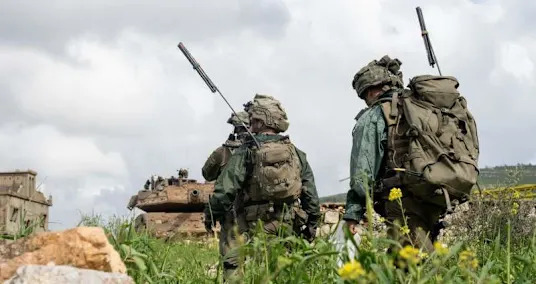
In 22 locations in the Golan Heights, the time will be extended from "immediate" to 15-30 seconds, depending on the town.
Beginning at noon on Tuesday, the IDF's Home Front Command will extend the time civilians have to reach shelter from the moment a siren sounds for rockets launched by Hezbollah in Lebanon toward Israel, the military announced on Monday.
In 22 locations, the time will be extended from "immediate" to 15-30 seconds, depending on the town. In another 14 areas, the time will be extended from 15 seconds to either 30 or 45 seconds. In eight areas, they will extend from 30 to 45 seconds, and in a further five, there will be no change.
At the five locations with no change, citizens have either 15 seconds or a full minute to find shelter after a siren sounds.
All 49 areas are in the Golan Heights or the Jordan River Valley area.
Most notable is at the Lebanese border, where sirens would sound 15 seconds before residents need to reach a safe space. Currently, there is no time from the moment a siren sounds to the moment residents need to take cover, and in many instances, Israelis hear the interception of missiles before a siren sounds. This includes the Druze town of Majdal Shams was among those listed, nearly two years after Hezbollah launched an Iranian-made rocket toward the town, killing 12 children playing outside.

"Changing [these] times expresses the paramount importance we place on the protection of human life," Home Front Command Chief Maj.-Gen. Shay Klepper said on Monday. "The change in the northern communities in the Golan Heights and the Jordan Valley is...part of a constant process of learning and adapting to operational reality."
"Extending the [siren response] times...will allow residents to be better prepared during an emergency," Klepper explained.
Hezbollah fires intense barrages of rockets towards Israel, IDF
In late March, Hezbollah fired over 600 times on Israel and IDF troops within a 24-hour period, doubling its prior high of around 300 aerial threats during the 2023-2024 conflict between the sides, IDF sources confirmed on March 27.
This major spike in Hezbollah attacks, up from a general average of around 100 attacks per day during the current war, occurred in the shadow of a possible end to the Israel-Iran war.
Since then, Israel's North has been bombarded daily and nightly with rockets and drones from Hezbollah in Lebanon, with some locations receiving alerts 6-8 times a day.
James Genn and Yonah Jeremy Bob contributed to this report.
latest_posts
- 1
 Idris Elba is the king of the stress-watch
 - 22024's Driving Clearing Robots: Master Suggestions and Surveys
- 3Virtual Route d: A Survey of \Exploring On the web Stages\ Web Administration
- 4Collection of 7,000-year-old ostrich eggs discovered under sand dunes in southern Israel
- 5Portugal among EU countries with the most people working close to 50 hours a week




- Journeys That could only be described as epic: Delightful Voyage Lines All over the Planet
- Manual for extravagance SUVs for seniors
- More loons are filling Maine's lakes with their ghostlike calls
- IDF confirms Iranian missile fragments hit near Kirya, multiple cars ablaze in Ramat Gan
- Investigate Business Mastercard Choices for Better Rewards and Rewards
- Hezbollah sees potential win as Israel backs down from disarmament goal
- Hamas set to elect new terror leader with Hayya, Mashaal in pole position
- Hundreds show fascist salute at rally in Rome in annual ritual
- How mountain terraces have helped Indigenous peoples live with climate uncertainty