Protests took place in Tel Aviv, Jerusalem, Haifa, and Beersheba, as a survey found broad but uneven support among Jewish Israelis for Operation Roaring Lion.
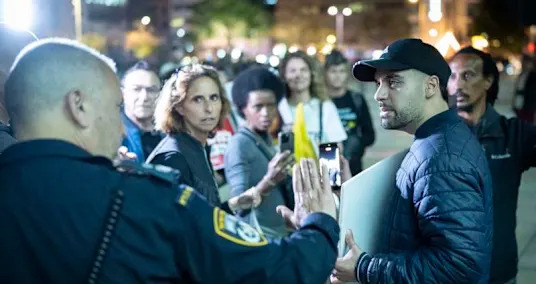
Israel Police arrested 21 anti-war protesters Saturday night as demonstrations against the conflict with Iran expanded in multiple cities despite restrictions on public gatherings.
Protests took place in Tel Aviv, Jerusalem, Haifa, and Beersheba, with hundreds of participants reported in Tel Aviv and Jerusalem and about 100 in Haifa, marking the largest turnout since weekly demonstrations began. Authorities said 13 people were arrested in Tel Aviv and eight in Haifa.
Police said the gatherings were not approved under Home Front Command regulations that ban events with more than 50 people. Officials said the increase in turnout followed calls by groups opposing the government to protest despite the restrictions.
“During a situation assessment that took place at the scene with a Home Front Command representative… it was clarified that there was a real risk to human life and accordingly, Yarkon [precinct] police commander Tzachi Sharabi ordered the gathering to be dispersed,” police said.
Hadash-Ta’al chairman Ayman Odeh, an Arab lawmaker involved in the protests, criticized the police response, calling officers fascists “in the service of the government” and saying they were afraid of “the heroic citizens who went out, despite everything, to make their voice heard.”

Survey shows broad, uneven support for war
The demonstrations come as a March 2026 survey by the Israel Democracy Institute found broad but uneven support among Jewish Israelis for Operation Roaring Lion. Support was strongest on the Right at 87% and about half on the Left.
The survey also found that Jewish and Arab respondents largely agreed that Iran’s resilience has been stronger than expected. Most Jewish respondents said Israeli society could sustain the campaign for up to one month, while 28% said as long as needed. Arab respondents were less optimistic about how long the public could endure the conflict.
A majority of Jewish respondents said Prime Minister Benjamin Netanyahu’s decision was driven by security considerations, while most Arab respondents viewed it as political.
latest_posts
- 1
 Minneapolis ICE shooting live updates: Protests continue over agent's killing of Renee Nicole Good; Walz puts National Guard on standby
 - 2New research reveals urban raccoons across the US show early signs of domestication
- 3Winter solstice 2025 marks the shortest day of the year in the Northern Hemisphere today
- 4Ukrainian man arrested in Germany on suspicion of spying for Russia
- 5The Leonid meteor shower is peaking early this week. Here’s what to know



- Central African Republic's president sworn in for a third term after disputed election
- Novo Nordisk cuts Wegovy price as CEO pledges to go 'all in' on weight loss pill
- New portrait of the oldest-known supernova | Space photo of the day for March 27, 2026
- Step by step instructions to Appropriately Keep up with Your Sunlight powered chargers for Most extreme Productivity
- Germany's Pistorius: NATO protects Europe from Iranian missiles
- Hamas delegation meets Egypt’s spy chief amid mutual ceasefire violation claims
- Norovirus is spreading earlier again this year, wastewater data shows
- Artemis 2 astronauts fly around the moon in record-breaking lunar loop by NASA
- Brazilian cardinal orders a popular Catholic priest to go offline following right-wing attacks